In 1995, something quietly changed the direction of global commerce. It wasn’t a breakthrough in hardware or a new financial system—it was a simple grey button labeled “Add to Shopping Basket.”
When Amazon first launched, the “Buy” button wasn’t just a UI element. It was a trust experiment. People were being asked to hand over sensitive financial information to a system they barely understood. At the time, clicking “buy” required faith as much as intention.
Fast forward to 2026, and that same action has been transformed beyond recognition. The “Buy” button is no longer just a clickable element. It is a voice command, a biometric confirmation, a gesture in augmented reality—and increasingly, a decision made entirely by autonomous AI agents.
To understand how we got here, we need to trace the evolution of the most powerful interface element in digital history.
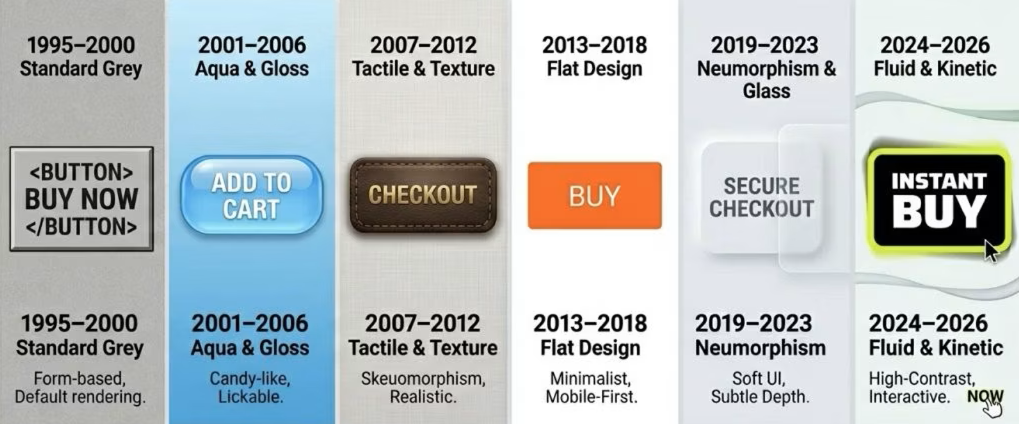
1. The Friction Era (1995–1999)
In the early web era, everything was slow, fragile, and uncertain.
Webpages loaded over dial-up connections. Online payments felt risky. Entering credit card details into a form felt closer to sending personal data into an unknown void than making a purchase.
The original “Buy” button was not persuasive—it was functional. It existed simply to complete a transaction that otherwise had no structure.
Early checkout flows were painfully complex: multiple pages, manual input of long card numbers, and constant fear of disconnection. One dropped connection meant starting over.
Then came a turning point.
Amazon’s introduction of 1-Click purchasing in 1997 changed the psychology of digital shopping. By storing user payment details, it removed the delay between intention and action.
That delay—the moment where users hesitate and reconsider—was quietly eliminated.
From that point on, the “Buy” button stopped being just a tool. It became a behavioral trigger.
2. The Trust & Consolidation Era (2000–2010)
After the dot-com crash, the internet matured. The challenge was no longer just usability—it was trust.
Users didn’t just want convenience; they wanted assurance that transactions were safe.
This era introduced intermediaries like PayPal, which acted as digital shields between users and unknown merchants. The “Buy” button evolved into a gateway backed by trust infrastructure.
By the mid-2000s, e-commerce shifted again with the rise of services like Amazon Prime. Now, clicking “buy” didn’t just mean paying—it meant receiving something quickly and reliably.
Speed became part of the product.
Surrounding the button itself, designers added layers of reassurance: security icons, verification badges, guarantees, and refund policies. The button was no longer isolated. It was embedded in a system of psychological safety.
3. The Mobile & Biometric Shift (2010–2017)
The smartphone fundamentally changed how humans interact with commerce.
On mobile screens, traditional checkout flows collapsed under their own complexity. The solution was simplification—eventually leading to biometric authentication systems like Touch ID and Face ID.
The “Buy” button became physical in a new way: it was no longer something you clicked—it was something you were.
A fingerprint or facial scan replaced forms and passwords. The act of purchasing became nearly invisible.
At the same time, interface design adapted to human ergonomics. Buttons moved into thumb-friendly zones. Purchasing became a one-handed, near-instant action.
Commerce was no longer a process. It became a reflex.
4. The Social & Ambient Era (2018–2023)
By the late 2010s, the “Buy” button stopped living inside websites.
It moved into feeds, videos, and conversations.
Social platforms turned inspiration into instant transaction points. A product seen in a post could be purchased without ever leaving the app. Commerce became contextual—embedded directly into attention itself.
Meanwhile, voice assistants eliminated screens entirely. Commands like “buy more coffee” transformed purchasing into spoken intent rather than visual interaction.
At this stage, the “Buy” button had effectively disappeared from view.
It still existed—but it lived in the background of everyday life.
5. The Agentic & Invisible Era (2024–2026)
Today, in 2026, the purchasing process is increasingly delegated.
Personal AI agents now handle shopping decisions end-to-end. They track preferences, monitor budgets, compare products, and negotiate prices.
Instead of browsing, users approve recommendations:
“I’ve selected the best option for you. Should I proceed?”
In many cases, even that final step disappears.
Smart environments automate consumption. Household systems detect low supplies and reorder products automatically. The decision to buy is no longer a moment—it’s a threshold.
With AR interfaces, the physical world itself becomes interactive. Looking at an object can trigger instant purchase options layered over reality.
The “Buy” button has effectively merged with perception.
6. The Rise of the “Undo Economy”
As purchasing friction disappeared, a new system had to emerge: frictionless reversal.
Returns are now as seamless as purchases. Logistics systems—powered by autonomous delivery and pickup networks—handle reverse flows almost instantly.
In many cases, buying is no longer a commitment. It is a trial state.
The presence of an effortless return mechanism is what enables frictionless buying in the first place. Confidence replaces caution.
Conclusion: When Buying Becomes Invisible
For three decades, digital commerce has been driven by one goal: reduce friction.
But friction was never just an inconvenience. It was a cognitive checkpoint. It created pause. Reflection. Doubt.
As that friction disappears, so does the moment of hesitation.
In 1995, buying required effort.
In 2010, it required trust.
In 2026, it requires almost nothing at all.
The “Buy” button hasn’t just evolved—it has dissolved into infrastructure, automation, and intent.
And in its place, a new question emerges:
Not how do we buy?
But how much of the buying are we still doing ourselves?