
Artificial intelligence is rapidly transforming web design, automating tasks that once required skilled professionals. What used to take hours—or days—can now be completed in a fraction of the time. Even a few years ago, developers using AI were already working twice as fast, and the technology has only accelerated since then.
But this progress comes with a serious question:
does the environmental cost of running AI outweigh the efficiency it creates?
On one hand, AI helps build faster, cleaner, and more optimized websites. On the other, the energy required to power AI systems keeps rising. As awareness of the digital industry’s environmental impact grows, designers and businesses are forced to confront this tension.

The Benefits: Where AI Supports Sustainability
AI has undeniably improved efficiency in web design. It automates repetitive tasks like generating responsive layouts, compressing images, and cleaning up code. This allows designers to focus more on creativity instead of routine work.
Faster workflows can also mean reduced energy use during development. If projects take less time, fewer computing resources are needed overall.
Beyond speed, AI is highly effective at identifying inefficiencies. It can analyze entire systems—CSS, JavaScript, and assets—to remove unused code and streamline performance. The result is lighter websites that load faster and consume less energy.
AI also improves caching and data delivery. Smarter systems reduce the need to repeatedly fetch data from servers, lowering energy usage across networks.
When it comes to media, AI can optimize images using modern formats like WebP or AVIF, reducing file sizes without noticeable quality loss. This significantly cuts data transfer and improves performance.
There’s also a user experience advantage. AI-driven personalization ensures visitors only receive relevant content. Fewer unnecessary assets are loaded, which reduces server requests and saves energy.
Additionally, AI can help meet accessibility standards early in development. This avoids costly redesigns later—saving time, money, and resources.
Taken in isolation, AI clearly contributes to more efficient and potentially more sustainable web design.
The Downsides: AI’s Hidden Environmental Cost
The problem lies in the infrastructure behind AI.
Large-scale AI systems depend on data centers, which already consume around 2% of global electricity. This number is expected to rise sharply as AI adoption grows.
Training advanced AI models produces emissions comparable to hundreds of long-haul flights. Even after training, daily usage (known as inference) continues to consume massive amounts of energy.
Tasks like image generation are especially resource-intensive. Creating a single AI-generated image can use as much energy as charging a smartphone.
Water usage is another overlooked issue. Data centers rely on cooling systems that consume enormous amounts of water—sometimes millions of gallons per day. Even a single AI query can indirectly require measurable water usage.
Hardware adds another layer of impact. AI depends on high-performance components like GPUs, which wear out quickly and are frequently replaced. This contributes to growing electronic waste, projected to reach millions of tons in the coming years.
Mining the materials for this hardware often involves environmentally harmful practices. If not properly recycled, discarded components release toxic substances into ecosystems.
To make matters worse, transparency is lacking. Many companies do not clearly report the true environmental cost of their AI operations. Some estimates suggest real emissions may be far higher than officially stated.
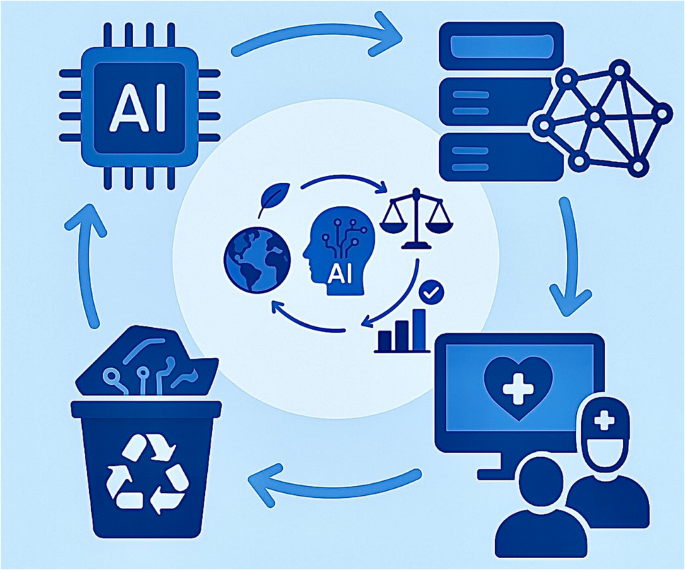
Do the Benefits Justify the Cost?
There’s a debate around how serious AI’s environmental impact really is.
Some argue its energy usage is still relatively small and that AI can help reduce emissions across industries through optimization.
Others point to research showing the opposite—that AI’s energy demand is growing rapidly and may soon represent a significant share of global consumption.
The truth likely sits in the middle: AI offers real efficiency gains, but its environmental cost is also very real—and growing.
Practical Advice: Using AI More Responsibly
AI isn’t going away. Businesses that ignore it risk falling behind. So the goal isn’t to avoid AI, but to use it wisely.
Start with the basics: build lightweight, efficient websites. Use minimal scripts, optimized images, and system fonts. A solid foundation reduces energy usage before AI even enters the process.
Then, choose tools carefully. Look for providers that are transparent about their energy use and committed to renewable resources. Smaller, task-specific AI models are often more efficient than large, general-purpose systems.
How you use AI matters too. Batch tasks when possible instead of running them continuously. Write clear, direct prompts to avoid unnecessary processing.
You can also offset some impact by using green hosting and optimizing content delivery networks to reduce data travel distances.
Finally, push for better standards. The industry needs clearer reporting and accountability around AI’s environmental footprint.
Conclusion
AI is both a powerful tool and a growing environmental concern.
It makes web design faster, smarter, and more efficient—but at a cost that often stays hidden behind the scenes.
The real challenge is balance. Use AI strategically, not blindly. Combine its strengths with sustainable design principles and informed decisions.
Ignore the trade-offs, and you contribute to the problem.
Understand them, and you can actually be part of the solution.