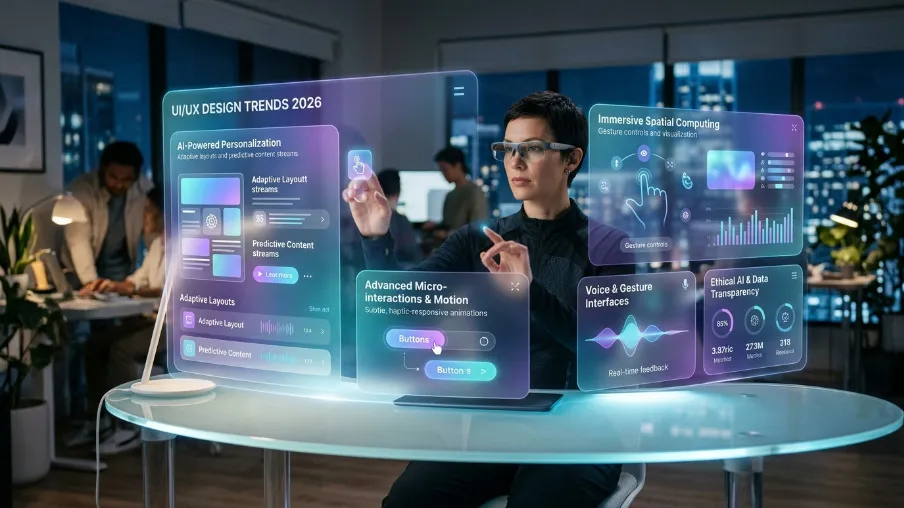
By 2026, the way people interact with digital interfaces has shifted far beyond traditional UX models like the F-pattern or Z-pattern. Those models assumed a static screen and a passive reader.
That assumption no longer holds.
Today’s users don’t simply “read” pages. They interact, filter, verify, and delegate. And their scanning behavior reflects that change.
We’re no longer designing for attention. We’re designing for intent.
The Collapse of Traditional Scanning Models
Classic UX research was built on controlled environments: a user, a screen, and predictable eye movement.
In that world, scanning patterns were stable:
- F-pattern for text-heavy pages
- Z-pattern for marketing layouts
But modern interfaces are no longer stable surfaces.
With AI-assisted browsing and intent-driven navigation, users often arrive at a page with their goal already partially processed. They’re not exploring—they’re validating.
Instead of scanning top-to-bottom, users now jump directly to elements that match their intent. Hero sections are often ignored entirely unless they contain immediate, relevant confirmation.
The hierarchy has shifted from visual order to relevance order.
Intent Anchors Replace Visual Flow
In 2026, users don’t follow layout—they follow meaning.
Pages are scanned based on “intent anchors,” which are elements that directly answer a user’s expected question:
- price
- outcome
- proof
- comparison
- action
If those anchors are missing or unclear, users don’t continue scanning—they exit.
This means hierarchy is no longer about prominence. It’s about match strength between user intent and on-page signals.
The most important element is not what is visually largest, but what resolves uncertainty fastest.
The Rise of AI-Mediated Scanning
A major shift comes from AI intermediaries.
Most users no longer interact with raw pages first. They see summaries generated by their AI assistant before they ever reach your site.
This creates a two-layer scan behavior:
- AI summary scan – users read a condensed interpretation of your content
- Verification scan – users jump into the page to confirm specific details
As a result, users don’t browse—they audit.
This changes hierarchy fundamentally:
- headings become verification points
- sections become fact containers
- UI elements become evidence anchors
If your content cannot be summarized accurately, it loses hierarchy entirely.
Spatial and Layered Scanning Patterns
With AR and mixed-reality interfaces becoming more common, scanning is no longer limited to 2D layouts.
Users now perceive interfaces in layers:
- foreground (interactive elements)
- mid-layer (content)
- background (context/system signals)
Attention is driven by depth, motion, and responsiveness rather than position.
Elements that react to gaze or proximity naturally rise in perceived importance. Static content, even if placed “above the fold,” becomes visually secondary if it lacks responsiveness.
Hierarchy is now dynamic and spatial, not fixed.
Interaction-First Hierarchy (The Pinball Model)
Another dominant behavior pattern is what UX researchers now describe as pinball scanning.
Instead of reading linearly, users jump between interactive components:
- sliders
- calculators
- filters
- previews
- live data widgets
Each interaction becomes a focal point, and supporting text becomes secondary context.
This reverses traditional hierarchy logic:
The most important message is not above the interaction—it is embedded inside it.
If a user is interacting with something, that is where their attention is locked. That is where meaning must be delivered.
What Modern Hierarchy Actually Depends On
Despite technological changes, hierarchy is still about reducing uncertainty. But the signals have evolved.
In 2026, users prioritize:
1. Clarity over creativity
If it takes effort to interpret, it loses priority.
2. Immediate semantic meaning
Headings must function as conclusions, not labels.
3. Interactive relevance
Movement and responsiveness signal importance.
4. Trust signals over visual decoration
Credibility is now a hierarchy driver.
5. Adaptive structure
Layouts that adjust based on user behavior outperform static grids.
Predictive Interfaces and Moving Hierarchies
Modern UI systems no longer assume fixed structure.
Instead, they:
- reorder content based on user behavior
- surface relevant actions dynamically
- collapse unused elements
- elevate predicted next steps
This means hierarchy is no longer designed once—it is continuously recalculated.
A call-to-action is no longer placed. It is positioned dynamically based on intent strength.
Writing for Scannable Intelligence
Content hierarchy has also changed.
Users no longer read deeply by default—they skim for validation points.
This leads to a new writing structure:
- sentences must carry standalone meaning
- headings must summarize entire sections
- paragraphs must resolve a single idea
- redundancy is removed entirely
The goal is not storytelling first—it is decision support.
The Real Shift: Pages Have Become Systems
The biggest change in UX hierarchy is philosophical.
Pages are no longer static compositions. They are responsive systems that:
- interpret intent
- adapt structure
- prioritize dynamically
- and respond to interaction in real time
Users don’t “scan pages” anymore.
They explore living interfaces that reorganize themselves around attention.
Final Thought
Traditional hierarchy assumed designers controlled the flow of attention.
Modern hierarchy assumes the opposite: attention controls the flow of design.
The best UX in 2026 isn’t the one users follow.
It’s the one that adjusts to them faster than they can decide where to look next.